The Black Sea region after the Russia-Ukraine war

Russia holds its strongest position in the Black Sea region since 1991 and is poised to strengthen it further, especially if its war against Ukraine ends to its advantage.
In a nutshell
- Russia’s war on Ukraine has worsened Black Sea geopolitics in the long run
- Moscow’s greater grip on northern and eastern littorals shifts the power balance
- Russian influence may grow on the western littoral into the Balkans and the heart of Europe
- For comprehensive insights, tune into our AI-powered podcast here
The Black Sea has an outsized geopolitical and geoeconomic influence. At the crossroads of Europe and Asia, its future and that of the greater Black Sea region depends on how Russia’s war against Ukraine ends. With costs increasing and diplomatic efforts intensifying, a ceasefire – though not an end to the battle over the future of Ukraine – looks more likely even as Russia has not budged from its maximalist political demands.
With United States President Donald Trump determined to broker an end to the war, it is important to consider how various war outcomes might affect the long-term future of the Black Sea region.
The Black Sea from Russia’s perspective
Russia has been pressing forward into the Black Sea region – territorially and politically – for more than 20 years, patiently but relentlessly rebuilding influence it lost after the collapse of the Soviet Union. Its current strategic position there is stronger than at any time since 1991. This has come after decades of kinetic and hybrid war, aimed at bringing additional territory under Russian influence or control.
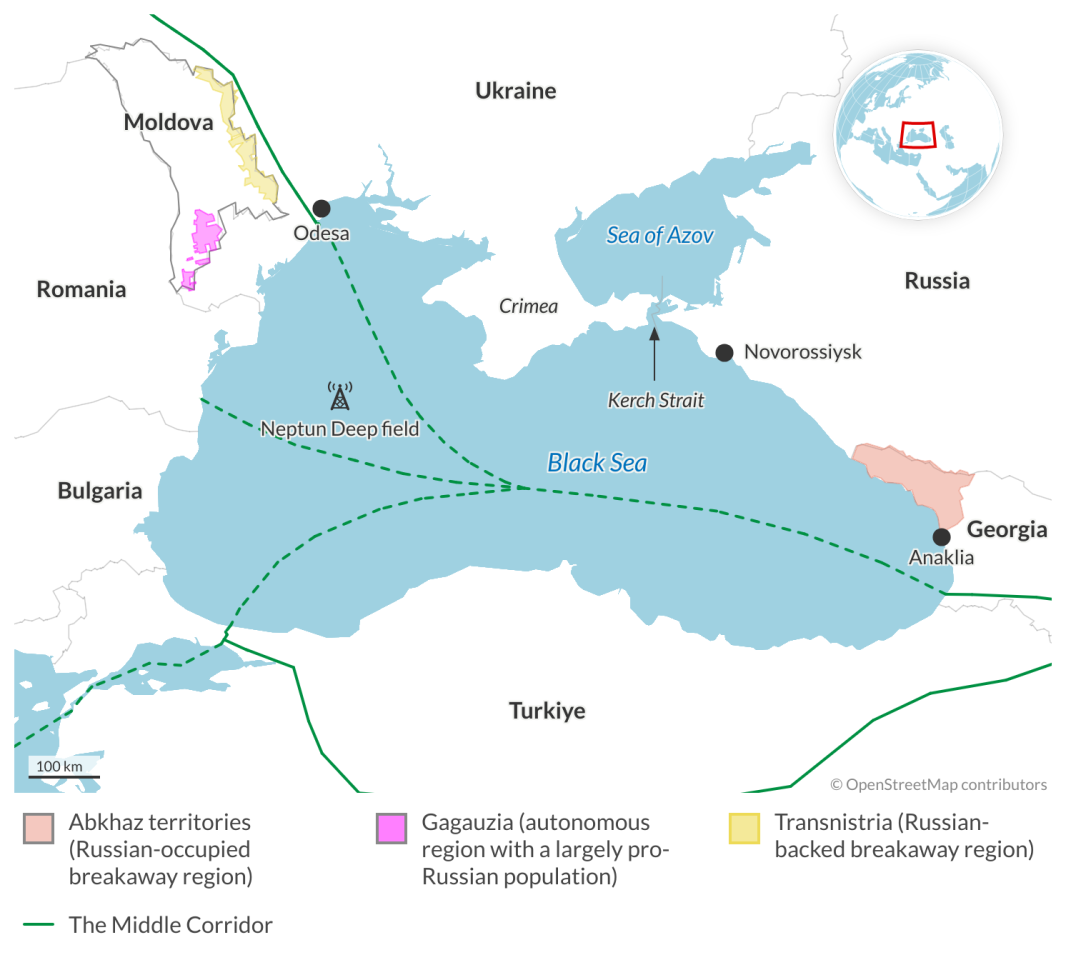
Ukraine is the most egregious case, with Moscow now occupying some 20 percent of the country. Its hold over Crimea and its resource-rich territorial waters and exclusive economic zone (EEZ), as well as the Donbas, potentially adding trillions of dollars to its mineral wealth. Russia remains deeply entrenched in the Transnistria region of Moldova, and has varying levels of influence in the country, as well as in Georgia, Turkiye, Bulgaria and Romania.
One widespread narrative is that an end to the war is by definition a win for peace, regardless of what that end looks like. Many pundits have asserted that Russian President Vladimir Putin has lost the battle of the Black Sea and is losing his war against Ukraine, citing the staggering military, human, economic, political, reputational and other costs to Russia, and that he is seeking to win at the negotiating table what it has lost on the battlefield. After all, President Putin and his military have been humiliated, suffering more than 1 million casualties, and about one-third of the Black Sea fleet is sunk or damaged. The economy is in ever poorer condition, and he is wanted by the International Criminal Court for war crimes.
An end to the war would be a positive story, but the facts present a different picture. Russia’s gains are of enormous strategic value and will increase further if President Putin ends the war on his terms. Absent substantially stronger pressure, spectacular wins by the Ukrainian forces or unlikely changes in Russian leadership and statecraft, the war will likely lock in a range of geopolitical and geoeconomic gains for Moscow. These include not only territory and an advantageous position in the Black Sea region, but also U.S. recognition as an equal – a status that Mr. Putin craves. Russia’s gains have already changed the balance of power in the region, and the impact could deepen if he achieves his ultimate goals.
Likely outcome favors Russia
Despite the Ukrainian forces’ spectacular successes in holding off and punishing the Russian army for close to four years, Ukraine is unlikely to regain all the territory the Kremlin has illegally seized anytime soon. Most endgame scenarios reflect strategic gains for Moscow and losses for Kyiv.
The first scenario is a negotiated ceasefire or truce with a frozen conflict. This would lock in the line of contact that leaves Russia in long-term control of substantial areas of valuable Ukrainian territory, possibly overseen by something like a “board of peace” as in Gaza or with a demilitarized zone. Another is a negotiated ceasefire or truce with Russia in control of all of Donbas Oblast, which Ukraine has rejected as unacceptable because it includes territory Russia has not won, as well as no NATO membership or weak security guarantees. A third scenario would see a negotiated ceasefire or truce that forces a “draw” on both parties that neither side wants.
An even worse scenario is a Russian breakthrough, achieved by outlasting Ukraine via attrition, or a crisis in Ukrainian leadership that forces Kyiv to sue for peace. Finally, there is the possibility that Russia scores a victory that includes capitulation and resolution of “root causes,” as well as other longstanding Kremlin demands. These remain non-starters for Ukraine.
The scenarios that favor Ukraine depend on variables that seem less likely at present, such as large increases in military support and economic pressure by the West, major Russian mistakes or losses, economic or political instability, or a coup in Russia. However, Ukraine has lost only about 1 percent of its territory since November 2022 while inflicting massive casualties on the Russians, suggesting that it can keep additional losses within bounds while continuing to inflict major economic damage far inside Russia.
None of these scenarios involves a Russian “victory” or a Ukrainian “defeat” in the traditional sense, but all leave the Kremlin in a more advantageous position, territorially and strategically, in the region than it was 20 years ago. In fact, the overall balance of power looks quite favorable from the Kremlin’s perspective. President Putin might be expected to promote the narratives that he has:
1) occupied 20 percent of Ukraine that Russia did not possess before 2014, including Crimea, and the vast riches of Donbas and the occupied EEZ;
2) engineered a government in Georgia that favors Russian interests and extends major influence, if not control, over the entire eastern littoral;
3) “defeated” NATO, “Europe,” and the U.S., even if none were direct parties to the war;
4) heightened divisions between the U.S. and Europe and within NATO, some of whose member states do not support the 5 percent defense spending pledge and maximum pressure campaign against Moscow, and who also send more hard currency to Russia than they provide support for Ukraine;
5) sown discord and division in NATO member states in the form of stronger pro-Russian political parties; and
6) swayed Turkiye, despite its pro-Crimea policy, through economic ties.
While President Putin will not say this outright, he will also be satisfied that he remains alive and that he continues to rule Russia as a unitary state.

Northern littoral
On the northern littoral, or coastal zone, of the Black Sea, the Russian occupation of Crimea is an exceptionally valuable military and geopolitical asset. From there, it can continue projecting power more easily across the Black Sea and beyond, even if a third of Russia’s Black Sea Fleet is destroyed, degraded or bottled up in Novorossiysk, oil terminals at the port of Tuapse have been hit and oil tankers that heretofore plied the Black Sea relatively freely have been sunk. Russia’s major military assets on Crimea will be very difficult to dislodge, while reinforcements for the Black Sea Fleet are likely to return to Crimea after the guns fall silent.
The Kremlin remains in full-court press mode in Moldova, even if voters there chose the West in September. Russia still enjoys considerable influence in the country, through pro-Moscow politicians and voters (not only in the Russian-speaking Gagauzia region), and can be expected to continue to deploy a range of hybrid tools to weaken the government’s policies. The nightmare scenario for Romania – Russian control of Ukrainian territory up to Transnistria and including Moldova, essentially making Russia a neighboring country – is currently unlikely, but it remains one of Moscow’s goals.
On the northern littoral, or coastal zone, of the Black Sea, the Russian occupation of Crimea is an exceptionally valuable military and geopolitical asset.
Ukraine controls enough of the northern littoral to have a maritime outlet to global markets. Russia’s goal of controlling Odesa and the entire coastline to the Romanian border remains a distant dream. However, on December 2, Mr. Putin restated his interest in cutting Ukraine off from the sea and taking Odesa, which he calls “a Russian city.” Moscow controls much of the coastline east of Odesa, all the Sea of Azov and the Kerch Strait. These formerly freely navigable waters are currently not free and open, despite Moscow’s signature on the 2003 Treaty on the Legal Status of the Sea of Azov and Kerch Strait.
It is important to remember the Kremlin mindset as reflected in Russian nationalist ideologue Aleksandr Dugin’s writings: “The absolute imperative of Russian geopolitics on the Black Sea coast is Moscow’s total and unfettered control over its entire length from the Ukrainian to the Abkhaz territories. The Northern Black Sea coast should be exclusively Eurasian and centrally subordinated to Moscow.”
Eastern littoral
Russia’s creeping state capture of Georgia has been a major success for President Putin, even if millions of Georgians contest the ruling party Georgian Dream’s dominance of the state. It is premature to say that Georgia is “lost,” but developments have been trending negative for years and the outlook is difficult.
Russian domination of Abkhazia and the naval base at Ochamchire give Moscow major influence in, if not control over, the entire littoral to the Turkish border. China has also been expanding its influence in Georgia, although its bid to build a deepwater port at Anaklia has stalled. Moscow may not want a port with such significant Chinese participation, however fraternal its ties with Beijing may be.
Western littoral
The Kremlin continues to use its many assets in Bulgaria, including pro-Moscow political parties and individuals, the Bulgarian Orthodox Church, historical economic links and pro-Russian sentiment, as well as a hybrid war toolbox to undermine this critical NATO member state. Still, recent governments there remain solidly pro-NATO and pro-EU, and the electorate clearly prefers the West. The government’s seizure of the Lukoil refinery in November and the U.S. administration’s sanctions against Lukoil were important steps in reducing Russian malign influence, but much remains. Bulgaria does not devote nearly as much attention to Black Sea security as does Ukraine or Romania. Sofia views the Black Sea more as a tourist destination than a source of problems, even after Russia has closed off sections of the Bulgarian EEZ for naval exercises and boarded commercial vessels there.
The Kremlin continues to sow and exploit societal discontent in Romania, long a bulwark of pro-NATO and pro-EU policies. Moscow has gained significant influence in the Romanian Orthodox Church hierarchy and among believers, as well as among supporters of the right-wing Alliance for the Union of Romanians party, which outpolls all others and is currently pushing 40 percent in popularity.
Russia has also been increasingly violating Romanian sovereignty. The Romanian Ministry of Defense noted that Russian drones have conducted about 50 strikes near the Ukrainian border since 2022. In 30 of these cases, drone debris was found on Romanian territory. On August 28, a Russian naval drone struck a Ukrainian vessel 30 kilometers up the Danube River from the Black Sea coast, on the Romanian border. These incidents receive much less attention than Russian provocations against Polish, Baltic and Nordic sovereignty, but they are no less concerning.
Corridor into Central Europe
If President Putin ends the war on his terms, Russian influence is likely to grow in Bulgaria and Romania. Russian efforts via weakening or capturing key state institutions or supporting pro-Moscow forces could over time create a corridor of instability from the Black Sea coast into the heart of Europe via Northern Macedonia and Serbia into Hungary and Slovakia. All of those countries have governments open or amenable to Kremlin interests.
This outcome is not inevitable, but a negative outcome of the war will exacerbate negative trends in the Black Sea region and ease Kremlin inroads into what President Putin sees as a potential soft underbelly of NATO. Such an eventuality would demonstrate yet again that Russia can successfully compete against NATO interests deep in its own territory. It would also signal to China, which is increasingly active in the Black Sea region, that the countries there are open to its malign influence.
Southern littoral
The Kremlin has not directly challenged core Turkish interests in the Black Sea region and profitable economic relations continue. Ankara has generally played a positive diplomatic role in the war. However, Turkiye must be wary that Moscow has substantially expanded its sphere of influence in the Black Sea region, especially after it recently hit three Turkish ships in Ukrainian ports. Ankara is unlikely to change its diplomatic recognition of the territorial integrity of Ukraine and Georgia. Nevertheless, as long as Russia remains respectful of Turkiye’s role in the southern Black Sea region and as “custodian of the straits,” and offers attractive economic ties, Ankara’s pragmatic approach to Moscow is likely to continue.
Ankara is also likely to continue interpreting the Montreux Convention strictly as long as the war continues. It can improve Black Sea regional security by ramping up de-mining and other joint efforts with Bulgaria and Romania and selling ships to the Romanian navy. It can do little to prevent the Kremlin from using Crimea to project power in the region, but it could reduce Russian militarization of the Black Sea by using the convention to prevent Russia from reconstituting its fleet to its pre-war size.
A Black Sea free and open for energy security and connectivity
The Black Sea is currently not free and open, even if commercial vessels ply its waters. Ships carrying grain and other goods to and from Ukraine are forced to hug the Romanian and Bulgarian coasts to reduce the risk of Russian harassment and mines. Ukraine has recently hit and sunk three vessels in the Russian shadow fleet. Although the Black Sea Fleet remains bottled up in Novorossiysk, it still threatens and attacks activity on the water. After hostilities end, Moscow will be well-positioned to intimidate maritime traffic or impinge on other states’ activities.
The large natural gas reserves in the Black Sea – in Romanian, Bulgarian and Turkish territorial waters or EEZs – must be developed because they are necessary to grow their economies, reduce reliance on Russian fuel sources and strengthen European energy security. In a Black Sea region with such significant Russian influence, the Middle Corridor could also become less successful as a trade route connecting Central Asia, the Caucasus and Europe.
Romania will become the largest gas producer in the European Union in 2027 when it begins exploitation of the 7,500 square-kilometer Neptun Deep field, which contains an estimated 100 billion cubic meters (bcm), for yields of 7-8 bcm per year. Romania has been producing gas from the Midea project (with U.S. investment) for several years. When Bulgaria begins to exploit the estimated 60 bcm in its Khan Tervel and Khan Asparuh fields, it will be able to cover its entire domestic production and export to the region.
Read more from Central Europe expert Matt Boyse
- Nawrocki victory shakes up Polish politics
- China increasing its bets on Hungary and Serbia
- Breaking the German-Polish deadlock
The Sakarya field in Turkiye contains an estimated 540 bcm, the largest of the Black Sea gas reserves. Turkiye has also served as a major transit route for Russian gas and oil, which it refines at several locations. It is an open secret that these fuels are of Russian origin, but they are still traded openly, reflecting market forces and continuing European refusal to decouple from Russia. Russia controls much of Ukraine’s huge maritime gas reserves and uses seized drilling platforms as much for military as energy purposes.
Senior Romanian and Bulgarian officials expect the Kremlin to use hybrid measures to interfere with exploitation of their reserves, many of which are located in their EEZs, are not subject to NATO Article 5 and are easier to disrupt. Russia has intruded into drilling zones in the past. Neither country has the naval forces to prevent interference in the development of these resources, which are very expensive to exploit and vulnerable when drilling and other infrastructure is being built. Moscow is less likely to interfere with the exploitation of Turkish Black Sea energy resources because of that pragmatic relationship.
A peaceful and stable Black Sea region can also support European energy security via the submarine electricity cable to be laid with participation by Azerbaijan, Georgia, Hungary and Romania. Two TurkStream gas pipelines and several data cables cross the Black Sea, strengthening connectivity with the Middle Corridor. Bulgaria’s recent decision to end Russian gas transit contracts on January 1, 2026, to fully exit the Russian gas market by 2028 and to switch to liquefied natural gas imports is a major step forward in reducing Moscow’s ability to blackmail Sofia.
Scenarios
The future of the Black Sea region depends on how Russia’s war against Ukraine ends. The stakes are highest for Ukraine, but they are significant for every other Black Sea littoral state and for those outside the strict geographic area – the Caucasus, Balkans and beyond, and under some scenarios even into Central Europe. The question is how NATO and the EU will deal with these emerging geopolitical realities.
Russia’s war against Ukraine has higher stakes than Mr. Putin’s stated goal of reincorporating the country into the Russian sphere, a strategy he considers indispensable to his efforts to restore Russian status and project power into adjacent theaters and onto the world stage. Ukraine and the Black Sea region are also the primary battlefields in his efforts to shape a new international order, together with China, Iran (another potentially key player in the Black Sea region) and others. While the West pays much and deserved attention to the Baltic region, Russia sees the Black Sea as the most strategic and vulnerable area on its borders. It remains the most important laboratory for the Kremlin to practice its combination kinetic/hybrid war against the West.
Likely: Security deteriorates
Barring a major turn of events in Ukraine and Russia, the security environment in the broader Black Sea region is likely to deteriorate further, especially if the war ends on President Putin’s terms. While an end to the hot phase of the war is likely to be generally welcomed, Kremlin control of so much additional strategic territory will solidify its much stronger geopolitical position. This cannot but have negative consequences for all the littoral states and beyond. The conditions of the period before 2008 are unlikely to return – the Kremlin will not give up areas it has illegally seized. This could well affect activity in the Middle Corridor, and China will be more present in the Black Sea region.
Moderately likely: NATO and EU countermeasures
NATO and the EU may start to pay more attention to the Black Sea to counter Russian and Chinese activity more robustly and strengthen deterrence. While focus from the EU, France and the U.S. Congress has grown in recent months, many other priorities are competing for their attention and resources. More active European engagement is critical, because the Trump administration has made it clear that it cannot bear more responsibility for Black Sea regional security than the Europeans.
Less likely: Greater U.S. engagement
More engagement by the Trump administration seems unlikely because it is already committed significantly via NATO in Romania, Bulgaria and Turkiye, and is currently prioritizing other regions and issues. Georgia needs more EU and U.S. attention, but both have in recent years approached the area in a way that reduces their influence.
Ankara could play a positive role as custodian of the straits by seeking to demilitarize the Black Sea, as that body of water was for a short period after the Crimean War, by preventing Russian warships from traversing the straits to reconstitute the Black Sea Fleet. However, it seems less likely to pick a fight with Moscow on that issue, even if Turkish leaders would prefer less Russian naval presence in the Black Sea. This issue should be a topic at the 2026 NATO summit in Ankara.
Contact us today for tailored geopolitical insights and industry-specific advisory services.

Sign up for our newsletter
Receive insights from our experts every week in your inbox.