Stability eludes Bangladesh as election date is set

Ahead of elections, Dhaka is struggling to stabilize the political scene, revive the economy and manage strained relations with its neighbors.
In a nutshell
- Political polarization deepens as elections near and unrest grips Dhaka
- Investors grow cautious as inflation rises and the garment sector falters
- Relations with India deteriorate, those with China and Pakistan improve
- For comprehensive insights, tune into our AI-powered podcast here
More than a year after student-led street protests forced the resignation and departure of former Prime Minister Sheikh Hasina Wajid, Bangladesh is still struggling to stabilize its polity, regain economic momentum and normalize relations with neighbors.
Amid internal and external challenges, the interim government led by Nobel Peace Prize laureate Dr. Muhammad Yunus, which was initially backed by the student movement and the Bangladesh military, has announced general elections for February 2026. The economy is struggling as social and political polarization discourage investors and signals instability to foreign businesses and partner countries.
Mob rule continues to disrupt law enforcement, and the government stands accused of repressing supporters of the former ruling party, the Awami League, which has been banned from the upcoming election. Hopes of ending government corruption and recovering funds allegedly stashed by officials in foreign banks have not been fulfilled.
While the country’s relations with China and Pakistan have improved, frictions with India have worsened and are hurting the economy and trade. Meanwhile, domestic tensions are rising over the continued presence of refugees from Myanmar and the potential that more will arrive. Islamist groups with significant influence among the students are gaining political leverage. These factors, coupled with reports of attacks on religious minorities, are causing concern about the future of Bangladeshi secularism.
Murky politics in Dhaka
The interim government is under pressure to balance reformist ambitions with demands from the army and opposition parties for political and social stability. The student leaders, some of whom are part of the Yunus cabinet, claim that the ouster of Sheikh Hasina Wajid in August 2024 was a revolution, giving the revolutionaries the mandate to rewrite the constitution and fundamentally alter the country’s political order before parliamentary elections.
Dr. Yunus’s announcement of an election date followed his consultations with the Bangladesh Nationalist Party (BNP) of former Prime Minister Khaleda Zia and the Islamist Jamaat-e-Islami, the two major remaining political parties after the ban on Sheikh Hasina’s Awami League, which ruled from 2009-2024. The election timeline, however, is at risk of slipping due to incomplete reforms and deteriorating security.
With the Awami League barred from running, the BNP and the Islamists have become the main contenders, though the interim government wants the National Citizens Party (NCP), led by students whose protests toppled the Hasina government and brought the interim government to power, to emerge as a third force.
Mounting military pressure ultimately led Dr. Yunus to announce an election date.
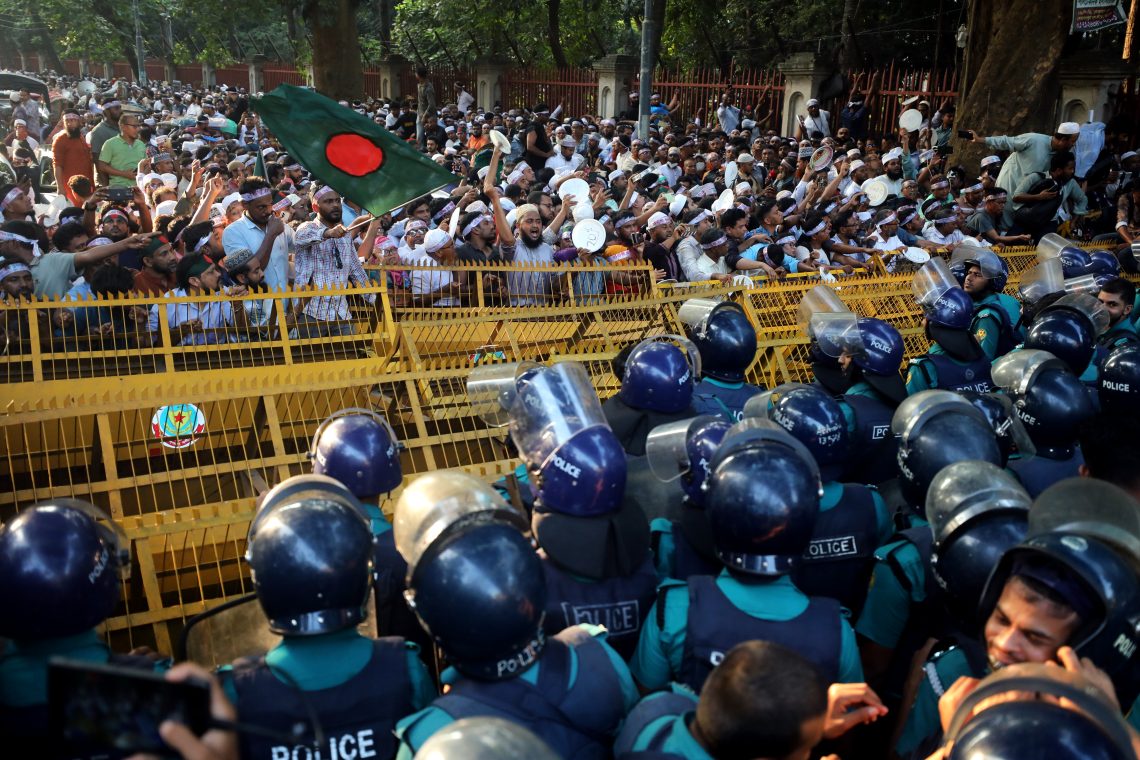
Despite initial hopes for progress, the Yunus administration has been unable to deliver on most fronts. Rival parties and factions have protested on the streets of the capital, Dhaka, with a string of competing demands. Even the military has voiced criticism of the government. The army chief, General Waker-Uz-Zaman, declared in a speech that Bangladesh was “passing through a chaotic phase,” and mounting military pressure ultimately led Dr. Yunus to announce an election date.
Mob violence has continued unabated, with regular reports of daylight shootings and lynchings. A clampdown on political freedoms, targeting the former ruling party, is also ongoing. In its May 2025 report, Human Rights Watch expressed concern over the government using anti-terrorism legislation to suppress the Awami League and its supporters.
The government has placed what it termed a “temporary ban” on meetings, publications and online speech supporting the Awami League. The party was also stripped of its registration. These decisions have created the perception of the Yunus administration favoring Jamaat-e-Islami and the NCP, which supported his rise, and have further polarized the political landscape.
Bangladesh’s mounting economic woes
The Yunus interim government inherited economic and social hardship from the previous regime. It now faces a perfect storm of political disenchantment, high inflation and adversarial interests of the groups within the current governing coalition. The country’s economy has continued to grow, but at a lower rate than expected.
Some economic indicators remain alarming. Agricultural output in August shrank for the first time in 10 months, weighed down by weaker demand, reduced activity and rising input costs. Furthermore, rice imports from Myanmar have declined over the last year, straining food security.
The garment sector has seen over 90 factory closures and 50,000 job losses due to labor unrest and violence. The services industry remains resilient, but here too the growth rate is slow. Foreign direct investment has dropped nearly 50 percent in the first quarter of 2025 compared with the previous year. Inflation remains high and, combined with high unemployment and a decline in real wages, has widened social and economic disparities.

What is more, tariffs imposed by the second Trump administration are exerting pressure on the already slow-growing readymade garments sector that forms the backbone of Bangladesh’s textile industry.
State-owned and private banks are plagued by mismanagement, high non-performing loans and deteriorated assets, while the banking system lacks sufficient liquid capital. At the end of April, the banks were unable to circulate new currency notes because the Bangladesh Mint did not have the capacity to cancel old notes and print new ones.
Bangladesh’s tensions with neighbors
Bangladesh’s economic growth is tied to relations with its neighbors and countries in the West. But relations with India are tense, largely because of the anti-India rhetoric of the interim government’s Islamist supporters and India’s past support of the Awami League. Dhaka continues to demand that New Delhi extradite former Prime Minister Sheikh Hasina, who is currently in exile in India. The current state of politics in the two countries is leading Bangladeshi leaders and ministers from neighboring Indian states to use incendiary language against each other.
The issue of what India has termed illegal immigration from Bangladesh into its northeastern states has long been an irritant for both New Delhi and Dhaka. But historically, the two states ensured that such issues and religious identity politics did not impact their diplomatic, trade and security ties. Despite signing a border agreement in 2015 and fencing the border between them, since February, deepening mistrust has resulted in occasional confrontations along the frontier.
For the last three decades, closer economic ties with India and the lowering of tariff and non-tariff barriers as well as opening borders between the two countries had provided Bangladesh with additional land and sea routes for trade and the Bangladesh-India-Nepal trilateral agreement for electricity import is still in place.
Facts & figures
Timeline of recent political instability in Bangladesh
2009-2024: Government under Sheikh Hasina Wajid marked by silencing of opposition figures, arrests, disappearances and alleged killings of dissidents
July – August 2024: Student protests over job quota reforms escalate into mass anti-government protests; brutal crackdown leaves over 1,000 dead, according to UN estimates
August 5, 2024: Hasina evacuates to India amid nationwide unrest
August 8, 2024: Interim government led by Nobel laureate Muhammad Yunus takes office
May 2025: Interim government bans all political activities of Hasina’s Awami League until trials related to protester deaths are completed
2026: National elections expected
Yet diplomatic relations with India have been tense since the summer of 2024. This past April, India canceled financing for a crucial logistics hub that allowed Bangladesh to use Indian territory to export goods to third countries such as Nepal and Bhutan, leading to trade complications. New Delhi’s decision followed a speech by Dr. Yunus that was interpreted by many Indians as an attempt by Dhaka to lay claim to India’s northeast region, while inviting Chinese investment into that region via Bangladesh.
Bangladesh is part of China’s Belt and Road Initiative (BRI) and has sought more investment from Beijing. Like Pakistan and Sri Lanka, it is eager to balance Chinese investment with that from other countries, yet friction with India and uncertainty over U.S. tariffs under the second Trump administration make that difficult.
Bangladesh also faces a challenge involving its eastern neighbor, Myanmar. Beginning in 2017, Bangladesh has hosted Rohingya refugees escaping persecution from Myanmar’s brutal regime, now totaling around 1 million people. Given Bangladesh’s severe economic and social distress, there is little public appetite to host additional refugees. A recent initiative proposed by Dr. Yunus for a “humanitarian corridor” was rejected by the military as a security risk.
The one country with which Bangladesh has improved relations over the last year is Pakistan – previously considered the oppressor from whom Bangladesh sought freedom through its war of liberation in 1971. Exchanges of high-level delegations have resulted in enhanced trade ties and the resumption of direct flights. But without transit through India, trade with Pakistan has relatively limited potential.
Bangladeshi voters still undecided
There are many uncertainties surrounding Bangladesh’s scheduled election, including the likely results. The ban on the Awami League has left BNP and Jamaat as the dominant contenders, with the NCP positioning itself as a reformist alternative.
Recent opinion polls show that roughly two-thirds of voters are still undecided, while polls from this February and March showed BNP at 42 percent, Jamaat at 32 percent, AL at 14 percent and NCP at 5 percent among likely voters willing to disclose preferences. The discrepancy between disclosed and undisclosed preferences suggests hidden support for the Awami League despite the ban. The League can be expected to increase pressure for inclusion in the political process as the election date draws nearer.
Read more by Husain Haqqani
- Pakistan’s perpetual crisis
- Nepal’s political and economic uncertainty likely to continue
- Sri Lanka’s new president looking for parliamentary backing
The Bangladeshi army, which supported Dr. Yunus’s rise and is increasingly concerned about law and order, Islamist influence and strained relations with India, wants elections to go ahead. In the event of a clear BNP electoral victory, even with a low turnout, the army will ensure that power is transferred to the party. But military intervention in case of unexpected election results, such as an Islamist victory, cannot be ruled out.
The BNP is promising to form a government of national unity, implying that it might include ministers from NCP and Jamaat in a future government. This would be a reprise of BNP’s coalition with Jamaat-e-Islami in 2001-2006.
Scenarios
Likely: Elections to take place but political strife to continue
The likely future for Bangladesh is that elections are held in February amid violence and a possible boycott by some parties, such as the NCP, over lack of fundamental changes to the country’s constitution. BNP wins with a low turnout and forms the government, but legitimacy issues, violence and protests by Awami League supporters continue to destabilize the country.
Less likely: A government of national unity emerges
BNP forms a government of national unity minus the Awami League, with the army’s support, and tries to govern without confrontation with India or the Awami League. The army could intervene to restore order, in case the election results lack legitimacy, are contested in the streets or result in a stronger hand for the Islamists.
Contact us today for tailored geopolitical insights and industry-specific advisory services.

Sign up for our newsletter
Receive insights from our experts every week in your inbox.