Delhi’s ambitious plan for naval power and strategic deterrence

A new 15-year defense strategy outlines India’s expansive naval modernization to counter growing threats from China and Pakistan.
In a nutshell
- Indian naval modernization driven by risks from China and Pakistan
- Investment for shipbuilding, ports, nuclear submarines and carriers
- Enhances maritime infrastructure to support global sea-lane security
- For comprehensive insights, tune into our AI-powered podcast here
On September 5, India’s Ministry of Defense unveiled a 15-year plan for comprehensive military modernization. It calls for hypersonic missiles for the air force, modern tanks and precision artillery systems for the army, indigenous drones and artificial intelligence in battlefield awareness, an offensive and defensive cyber warfare strategy as well as a new space warfare doctrine. Of particular note is the great attention paid to surface and submarine naval expansion.
The announcement came four months after the Indian military launched Operation Sindoor, its retaliation on Pakistan for the death of 26 Indian civilians in Indian-administered Kashmir on April 22. The incident was followed by a week-long armed conflict between the two nuclear states. Another major factor driving India’s new strategy has been two decades of Chinese naval modernization that has transformed its navy into the largest and one of the most lethal forces on the high seas.
India’s national security and economic strategy rests upon a free and open maritime domain. The majority of Indian goods (over 855 million tons annually) transit global shipping lanes, underscoring the need to keep the seas safe from Chinese maritime expansion and Pakistan’s growing submarine fleet.
The new plan supports the Indian Navy’s task of protecting a vast maritime area that spans from the Persian Gulf, along Africa’s eastern seaboard and into the Indian Ocean and South China Sea. Roughly 95 percent of India’s external trade by volume and 77 percent by value flow through these waters.
The plan also provides for a robust shipbuilding industry and a production pipeline to strengthen India’s defense and economic capabilities. Each shipyard job is estimated to create five to six jobs in supplying industries like transport and steel, generating a multiplier effect of 1.8 on the domestic economy. This aligns with Prime Minister Narendra Modi’s Aatmanirbhar Bharat strategy for a self-reliant India.
The Indian Navy by the numbers
The Indian Navy currently operates around 150 warships, including aircraft carriers, destroyers, frigates, corvettes, amphibious ships, nuclear-powered ballistic missile submarines (SSBNs) and diesel-electric submarines – many of which are aging and in need of replacement.
Under the 15-year plan, the fleet would grow to around 230 vessels by 2037. By 2040, the navy could have up to four aircraft carriers, with approximately 170 carrier-based aircraft and expanded maritime unmanned aerial vehicle (UAV) squadrons for surveillance and anti-submarine warfare.
The most important part of this plan is a future domestic naval production program that will provide the resources for 10 nuclear propulsion systems. These would power new ballistic missiles and attack submarines, and possibly a nuclear-powered aircraft carrier.
Facts & figures
The Indian Navy’s shopping list
The 15-year plan includes calls for the acquisition of the following:
- The addition of four large landing platform docks of up to 29,000 tons for amphibious and expeditionary operations
- Up to 10 10,000-ton next-generation stealth destroyers and new frigates for sea control
- Five 40,000-ton fleet tankers to extend endurance at sea
- Fast-expanding littoral security forces with 100 high-speed interceptor craft and 20 remotely operated interceptor boats
Additionally, by 2040, New Delhi plans to have:
- Over 120 medium-altitude-long-endurance (MALE) UAVs
- 30 combat MALE UAVs
- 20 high-altitude-long-endurance (HALE) UAVs
- Over 150 shipborne UAVs
Providing adequate resources and mastering new technologies will be the biggest challenge to the Modi administration’s success in restoring Indian naval power. Of these programs, the most important − and complex − are aircraft carriers and nuclear-powered submarines (both ballistic missile and attack), neither of which India has yet mastered.
Building and fielding a carrier and nuclear submarine force
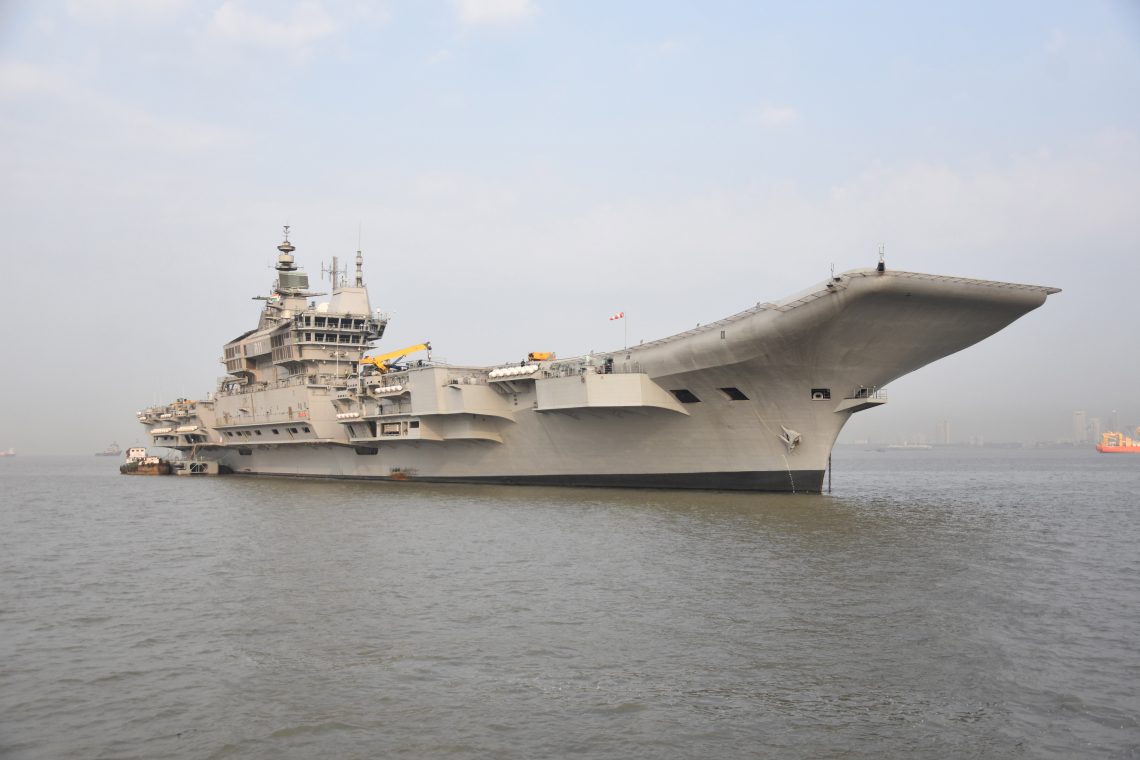
Aircraft carriers are one of the two central pillars of India’s blue-water ambitions. Today, the Indian Navy operates two 45,000-ton conventionally powered ski-jump big deck carriers: the INS Vikramaditya, built by the Soviet Navy in 1987 before being sold to India and re-commissioned in 2004; and the first domestically-built carrier, the INS Vikrant, commissioned in 2022.
Given its age, the Indian Navy has planned since 2013 to forgo refitting the INS Vikramaditya and instead replace it with a second indigenous aircraft carrier, a larger boat at 65,000 tons that would enable India to transition from the ski-jump ramp to the catapult-assisted take-off but arrested recovery (CATOBAR). By incorporating CATOBAR, the Indian Navy’s envisioned aircraft carrier, INS Vishal, would have higher fuel and ordnance take-off weight capacity, thus extending combat ranges and power projection.

In 2015 the United States government indicated it supported selling India the Electromagnetic Aircraft Launch System (EMALS), which could enable the launch of larger aircraft and combat drones. The Indian Navy reached out to four other foreign naval firms seeking information on technical and cost proposals for the EMALS program. By October 2017, the first Trump administration approved the release of EMALS technology to INS Vishal.
However, under the new 15-year defense plan, EMALS for INS Vishal is slated to be indigenously built with assistance from private sector companies. The Indian Navy is also expected to procure two EMALS units with arresting and restraining gear units for each of its future carriers.
The second critical pillar − and shortfall − for the Indian Navy is its submarine fleet.
The Indian Navy has concluded that the expensive and complicated technology is essential for it to keep pace with China’s aircraft carrier program. Beijing in 2024 showcased dual carrier operations and unprecedented fifth-generation stealth fighter operations aboard its newest carrier, the Fujian. For the first time, it launched and recovered J-35 and J-15T fighter jets and the KG-600 fixed-wing aircraft via an EMALS. The technology was pioneered by the U.S. Navy and installed aboard the $13 billion USS Gerald R. Ford, which was commissioned in 2017.
The second critical pillar − and shortfall − for the Indian Navy is its submarine fleet. Currently, it fields just 19 boats: two indigenously built Arihant-class ballistic missile submarines (SSBNs) and 17 diesel electric submarines (including six modern Kalvari-class boats, the export variant of the French Scorpene-class or Project-75 [India] submarine), alongside four older German HDW and seven Russian Kilo-class variants.
By comparison, the Chinese Navy now has over 60 submarines and its fleet is projected to expand to 76 vessels by 2030. That will include eight SSBNs, 13 nuclear-powered attack submarines and 55 diesel-electric submarines.
Largely in response to China’s nuclear submarine force and the transfer of the third of eight Hangor-class diesel submarines (the export version of the Yuan-class) from China to Pakistan, India will increase its fleet up to 30 submarines. The plan also calls for building six more Air Independent Propulsion equipped submarines under P-75(I) from both their Mazagon Dock Shipbuilders and Germany’s Thyssenkrupp Marine Systems.
These new boats will be equipped with advanced submarine-launched ship- and land-attack cruise missiles for sea-denial and land-strike roles. The underwater domain will be reinforced with 20 long-endurance unmanned undersea platforms for anti-submarine warfare, supporting both traditional submarines and surface vessels in monitoring enemy activity.
India’s nuclear submarine aspirations
Another key task for India’s national defense strategy and military modernization plan pertains to the navy’s nuclear submarine program and the establishment of a credible sea-based nuclear deterrent of SSBNs and fast-attack nuclear submarines (SSN).
The strategic rationale for building the sea-based leg of India’s nuclear deterrence program comes from its position between nuclear-armed neighbors China and Pakistan, and China’s growing influence and naval power across the Indian Ocean. Likewise, the 2020 Galwan Valley clash with China and the August 2025 aerial combat with Pakistan have undeniably intensified India’s perceived need for survivable second-strike capabilities.
Having Indian Navy SSBNs deploying submarine-launched ballistic missiles (SLBMs), protected by SSNs, provides New Delhi a survivable leg of a nuclear triad. With only two operational SSBNs, India significantly lags China’s six Jin-class ballistic missile boats, which are armed with JL-2 and JL-3 missiles capable of ranges exceeding 9,000 kilometers. This highlights a substantial capability gap that undermines India’s desire for a credible sea-based nuclear deterrent option.
Facts & figures
The history of India’s nuclear submarine program
The Indian Navy’s nuclear submarine experience has a checkered past, historically relying on leasing Russian nuclear submarines. India was the first country to lease a nuclear-powered submarine from another nation when, in 1988, it acquired its first Soviet Navy Charlie-class nuclear-powered cruise missile submarine (SSGN), renamed Chakra I. In 2012, India leased a Russian fast-attack Akula-class SSN, named Chakra II, for a 10-year period. While both submarines have since been returned to Russia, the Indian Navy’s dependence on Russian support continues. Another scheduled lease from Russia, of the INS Chakra III, an Akula-class SSN, is expected to join the Indian fleet by 2028.
Along with a reliance on Russian submarine technology, the Indian Navy’s nuclear submarine force faced a severe operational setback when its first indigenously produced SSBN, the INS Arihant, suffered a major propulsion system malfunction, rendering it inoperative for nearly a year. India also lacks an operational nuclear attack submarine force, a critical gap in ensuring the survivability of its SSBN fleet.
As it pertains to India’s nuclear triad, the existing two 6,000-ton Arihant-class SSBNs, INS Arihant and INS Arighat, were initially equipped with K-15 ballistic missiles with ranges of 750 kilometers. Given the limited range of these missiles, the Indian Navy developed and is fielding the K-4, a new missile modelled on the Agni-III intermediate-range ballistic missile with a range of 3,500 kilometers, offering a substantial leap in capability and range. From patrol zones in the northern Bay of Bengal, the K-4 may reach some Chinese targets, greatly enhancing operational flexibility. A third submarine of the class equipped with the K-4, the 7,000-ton INS Aridhaman, was built under the Advanced Technology Vessel (ATV) project at the Ship Building Centre in the port city of Visakhapatnam and is expected to be commissioned in 2025.
A fourth Arihant-class SSBN is already under construction as part of the ATV project that includes the development of 13,500-ton SSBNs and six nuclear-powered SSNs, designed for other conventional naval warfare missions.
Facts & figures
Maritime and onshore hotspots and infrastructure
Like the navies of Russia and China, the Indian Navy has developed a plan for a sea-based nuclear second-strike capability, known as a “bastion strategy.” This would allow Indian SSBNs to operate in relative protection within the waters of the Bay of Bengal and the northern Indian Ocean, rather than pursuing Continuous At-Sea Deterrence (CASD) patrols like the U.S. Navy. Yet due to technical challenges such as reactor endurance issues, inadequate stealth capabilities and vulnerability to low-frequency acoustic detection systems, some naval experts estimate India will need up to 60 years before conducting credible CASD patrols.
Port enhancements: Project Varsha and Seabird
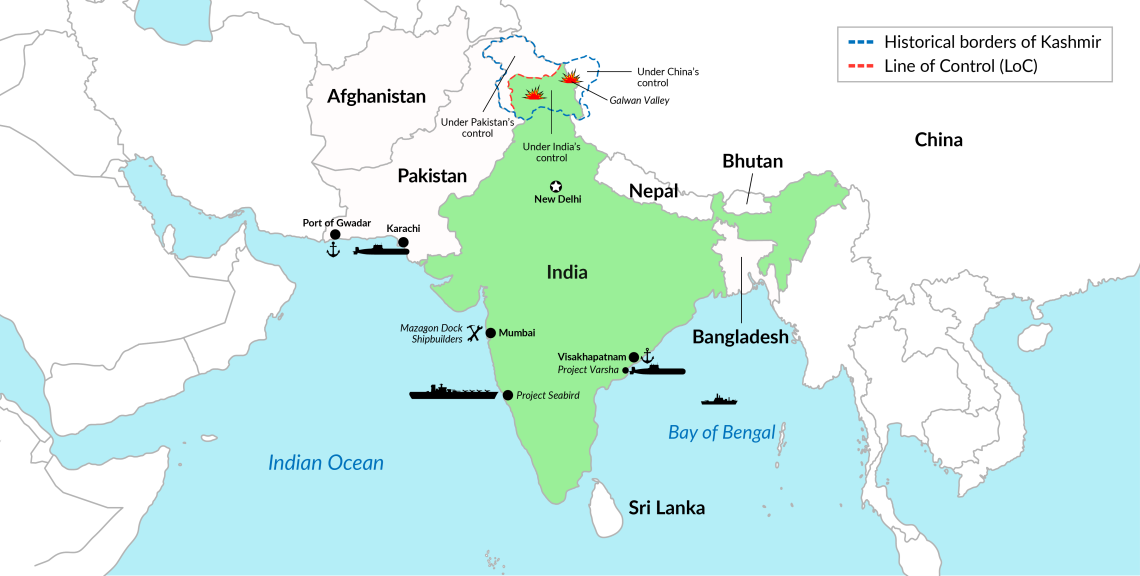
To build an Indian Ocean “bastion,” not just for ballistic missile submarines, but for all of India’s maritime interests, the Indian Navy has developed two major naval port projects. The first, Project Varsha – a massive development on India’s eastern seaboard – will expand an existing submarine base 50 kilometers south of Visakhapatnam at Rambilli with hardened underground pens for nuclear submarines. It is expected to be operational by 2026. This new base will enable India’s SSBNs to enter the Bay of Bengal covertly, evading satellite surveillance, and to conduct CASD in protected bastions.
Read more by naval expert Captain James E. Fanell
- The future of the U.S. Navy
- The Trump maritime strategy
- The changing nature of naval power in the Pacific
On the western front, Project Seabird at Indian Naval Station (INS) Karwar, serves as a comprehensive naval base housing both of India’s aircraft carriers and a number of destroyers. Under a two-phase expansion project, the base will accommodate up to 50 major warships with expanded dockyards, logistics hubs and naval aviation support services.
Scenarios
More likely: Revitalized Indian naval power
India’s naval modernization program, largely driven by China’s own two-decade naval modernization program and the ongoing armed confrontation with Pakistan, has unified the Indian political landscape. This latest plan demonstrates the Modi government’s commitment to expanding India’s maritime power in support of the country’s national security requirements.
With the successful growth of aircraft carriers, modern submarines, nuclear-powered platforms, next-generation destroyers and amphibious forces, together with an aerospace component including advanced drones and strike aircraft, the Indian Navy will be well positioned against its adversaries. It will be able to deliver an assured second-strike capability from a bastion-focused SSBN deployment strategy, while simultaneously being able to robustly safeguard critical sea lines of communication within the Indian Ocean region and later globally.
Less likely: Continued diversions of effort and resources
The Indian Navy’s path to becoming a 200 plus ship force faces the challenge of overcoming historic failures in expanding the country’s domestic shipbuilding efforts. The clear dilemma for the Modi government and beyond is in balancing strategic necessity, industrial development, shipbuilding throughput and geopolitical rivalries. New Delhi will also need to sustain steady investment while simultaneously developing advanced naval aviation and undersea systems.
While the introduction of new submarines, missile systems and support infrastructure is a positive step forward, the Indian Navy must also overcome cautious doctrine, infrastructural lag and a deliberate posture of restraint, which has unfortunately marked it for much of its history.
Contact us today for tailored geopolitical insights and industry-specific advisory services.

Sign up for our newsletter
Receive insights from our experts every week in your inbox.