Stabilizing Gaza under the Trump plan

A historic U.S.-mediated ceasefire in Gaza offers hope for peace, but regional dynamics and doubts about Hamas’s compliance challenge its fragile sustainability.
In a nutshell
- The Trump Peace Plan ended two years of war between Hamas and Israel
- The first phase of the Gaza peace plan has gone well
- Implementing the next phase requires strong international backing
- For comprehensive insights, tune into our AI-powered podcast here
The Middle East is often volatile and unpredictable, and Gaza – with its recent history of Hamas-instigated conflicts – is particularly dynamic. The latest ceasefire, facilitated by United States President Donald Trump and his team, is at a crucial juncture: Will it hold up under international scrutiny or could it collapse into another round of Israeli offensives if Hamas resists demilitarization? This ongoing cycle of conflict and attempts at peace underscores Gaza’s precarious peace.
A recent history of violence in Gaza
In the past 18 years, the people of the Gaza Strip have endured four wars. The first was a Palestinian civil war in June 2007 between Fatah, the largest faction of the Palestinian Liberation Organization, and Hamas, an autonomous branch of the Muslim Brotherhood. Israel had completely withdrawn its troops and settlers from Gaza two years before, in 2005.
During that conflict, Hamas ousted Fatah and seized control of the Gaza government. In response, both Egypt and Israel tightened their borders with Gaza and closely monitored the movement of goods and people entering and leaving the area.
Shortly after the coup, Hamas began launching rockets and missiles from Gaza into Israel. Initially, these attacks targeted Israeli towns and farming villages near Gaza, but soon they expanded to strike more distant locations, including Tel Aviv, which is approximately 64 kilometers from Gaza. These continuous attacks triggered two ground invasions by Israel, in 2009 and 2014, each followed by ceasefire agreements and subsequent withdrawals of Israeli forces.
After the 2014 war, the Israeli security establishment believed (incorrectly) that Hamas was effectively deterred, or at least had become a manageable security threat. The militant group sporadically resumed intense missile attacks on Israel, for instance, in May 2022, which prompted retaliatory airstrikes from Israel, and further ceasefire agreements.
The fourth Gaza war began at dawn on October 7, 2023, when thousands of Hamas fighters, along with allied terrorist groups from Gaza, invaded Israel. This surprise attack caught the Israel Defense Forces (IDF) off guard, resulting in Hamas’s capture of around 10 villages, towns and military posts. During the extensive Israeli counteroffensive, more than half of Gaza’s buildings and a significant portion of its infrastructure were destroyed; entire city blocks and neighborhoods were flattened. Israel has reported approximately 850 civilian and 900 military fatalities, while Gaza’s casualty figure, cited by Hamas, stands at 69,000. Hamas does not distinguish between civilian and militant deaths within Gaza.
This two-year war, the fourth and most destructive, was punctuated by numerous temporary truces, but the U.S.-mediated Trump Peace Plan signed on September 29 seems to have brought it to a close. Since then, although there have been isolated Hamas attacks on Israeli soldiers, followed by Israeli retaliatory airstrikes, the ceasefire has largely held.

Will the armistice last?
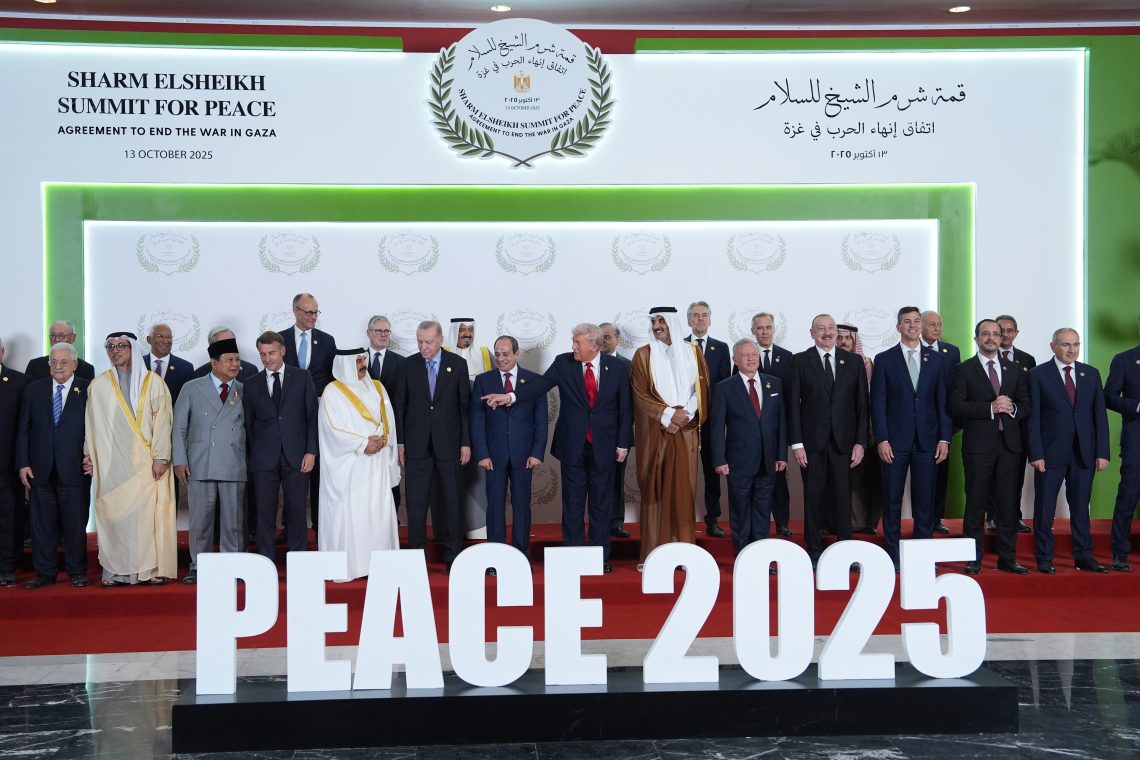
What sets the latest truce between Hamas and Israel apart from previous ones is its foundation in a 20-point peace plan. It was crafted by U.S. envoys Jared Kushner and Steve Witkoff, with direct involvement from President Trump. Notably, it was also coordinated in advance with Gaza’s neighboring countries, Israel and Egypt, as well as with two important American allies in the region, Turkiye and Qatar, who are also key backers of Hamas. On October 13, Egypt hosted the Gaza Peace Summit in Sharm el-Sheikh, where 30 nations announced their support for the Trump Peace Plan.
This ceasefire is likely to last. Both Israel and Hamas are exhausted from fighting after two years. But even more important to the plan’s success is the Trump negotiation strategy.
Mr. Trump and his team took proactive steps by reaching out to Turkiye and Qatar, successfully aligning them with his plan. This was achieved by offering incentives that catered to each country’s national interests: Doha received a U.S. security guarantee, while Ankara received a tentative promise of advanced military aircraft. Unlike previous American mediation efforts between the Palestinians and Israelis, this time the Palestinians faced nearly united regional backing for the U.S. proposal.
In contrast, when President Bill Clinton tabled the Clinton Parameters for Israeli-Palestinian peace in 2000, the key regional supporters of the Palestinians were not on board in advance. As a result, the Palestinian side felt emboldened to reject the proposal, while the Israeli government of Prime Minister Ehud Barak accepted it.
Perhaps one of the main reasons President Trump was able to rally the entire region – excluding Iran – behind his Gaza peace plan was his military strike on Iran’s nuclear facilities just three months prior. This precise operation, which targeted Iranian nuclear centrifuges without causing collateral damage, sent a strong message to U.S. partners and allies in the region, all of whom had been deeply concerned about Tehran’s nuclear ambitions. Mr. Trump leveraged this goodwill to garner a broad endorsement for his peace plan.
What is in the plan?
Another crucial aspect of the success of the Trump Peace Plan is that it aligns with Israel’s primary war objectives. These terms enable Jerusalem, with its troops already positioned in Gaza, to fulfill its goals without causing further bloodshed.
Israel gets back its hostages, both alive and deceased, while retreating to positions inside Gaza that allow it to maintain control over all border crossings into Gaza, including Rafah on the southern border with Egypt. In return, Israel released 250 Palestinian prisoners convicted of terrorist crimes and an additional 1,700 Gazans detained since the start of the war.
Facts & figures
Withdrawal of Israeli forces from Gaza under the Trump Peace Plan

Gaza undergoes a “process of demilitarization under the supervision of independent monitors.”
Hamas surrenders governance to a “temporary transitional” committee (or a transitional government) composed of “qualified Palestinians and international experts” with oversight from a Board of Peace chaired by President Trump and including other heads of state.
A temporary International Stabilization Force will be deployed to Gaza to oversee security and to begin training a Palestinian police force. Israel then initiates a withdrawal from its positions within Gaza, transferring control of the territory to the International Stabilization Force. This transition aims to establish a durable peace, guided by specific milestones related to the demilitarization of Hamas.
Finally, as redevelopment in Gaza progresses and the Palestinian Authority is reformed, “conditions may finally be in place for a credible pathway to Palestinian statehood.” The U.S. will initiate a dialogue between Israel and the Palestinians to discuss a political framework for the future of the Palestinians.
Facts & figures
What is the Board of Peace?
The Board of Peace will be responsible for overseeing the transitional governance and reconstruction of Gaza. A technocratic committee, composed of vetted Palestinians from both the diaspora and Gaza, along with international experts, will oversee day-to-day administration, economic recovery, deradicalization efforts and the provision of essential services. This committee will operate under the board’s authority and will not include members of Hamas.
The hard part begins now
With the Trump 20-Point Plan now accepted throughout region, the international community is focused on its implementation. To contribute meaningfully – through financing, peacekeepers and police, civilian aid and governance staff – many countries require that the post-Hamas transitional regime in Gaza have international legal legitimacy. The preferred path for many contributors is a United Nations Security Council resolution. The U.S. collaborated with its allies to pass a resolution that will provide the post-Hamas transitional government, as outlined in the Trump Plan, with an internationally accepted foundation.
The next issue concerns Hamas, which still controls half of Gaza and most of its population. The group is under pressure from its regional supporters to fulfill its part of the demilitarization, followed by the transfer of power to the transitional government. The Trump plan stipulates that Hamas must demilitarize (not disarm), which means that at the very least it needs to give up its missiles and other heavy weaponry. The distinction between demilitarization and disarmament could become a significant point of debate.
Read more about the Middle East
- The resurgence of Egyptian diplomacy
- Countries recognize Palestine: Will it be different this time?
- Who will win the competition for influence in Syria?
If Hamas does not conduct demilitarization, then implementation of the Trump plan can begin in the part of Gaza that will be designated as the international zone, once the IDF withdraws. This will enable the transitional government to gradually facilitate the movement of Palestinians from the Hamas-controlled area to the international side.
Who will provide troops for the International Stabilization Force? Assuming there is progress on Hamas demilitarization and on IDF phased withdrawals, contributions are likely to come from a mix of Muslim-majority countries, such as Indonesia and Azerbaijan, as well as from European militarized police with experience in post-conflict situations, such as the Italian Carabinieri.
The implementation issues to be addressed are numerous. Obtaining a UN Security Council resolution is the crucial first step in securing support from the global community.
Scenarios
Most likely: The Trump Plan is implemented
With backing from much of the global community, especially key U.S. allies in the Middle East such as Saudi Arabia, the United Arab Emirates, Qatar, Turkiye and Egypt, the Trump Plan has momentum. However, implementing peace agreements is often much more challenging than simply signing them, as demonstrated by the West’s experiences in ending the civil war in Bosnia.
With the passage of the U.S.-drafted UN Security Council resolution, and provided a transitional government composed of a balanced mix of Palestinians and international experts (to prevent a resurgence of Hamas) is established, there is a very good chance of ending the cycle of violence in Gaza.
Less likely: The stalemate continues and Israel continues to occupy half of Gaza
Israel has pulled back, in line with phase one of the Trump Plan, to agreed-upon locations that allocate half of Gaza to Israel while Hamas controls the other half. If the implementation of the Trump Plan stalls, these current lines may solidify into a de facto division, creating distinct zones: one held by Hamas and the other by the IDF.
Least likely: Hamas refuses to implement the Trump plan
Hamas is an Arabic acronym for the Islamic Resistance Movement, indicating that its core identity is centered around the principle of armed resistance. It could decide to take its chances, given its ability to fight from its still-extensive tunnel system. If Israel decides it has no choice but to defeat Hamas militarily, Gaza and its population will face further destruction, and Jerusalem will likely face renewed criticism from the global community.
Contact us today for tailored geopolitical insights and industry-specific advisory services.

Sign up for our newsletter
Receive insights from our experts every week in your inbox.