How Italy is increasing its footprint in Africa

The Mattei Plan is strengthening Rome’s African partnerships and redefining Europe’s geopolitical role.
In a nutshell
- Italy is advancing a pragmatic, partnership-driven approach to Africa
- Energy, migration and infrastructure are central to the strategy
- Success hinges on institutional stability, managing intra-EU competition
- For comprehensive insights, tune into our AI-powered podcast here
Africa is becoming a more competitive geopolitical arena, creating openings for new political, commercial and security alliances. Former colonial powers such as France have lost much of their influence, creating a security vacuum in the Sahel that Russia has been keen to fill. Meanwhile China, India and Turkiye are finding ways to bolster their influence. All this is unfolding as Italy’s role in Africa is growing.
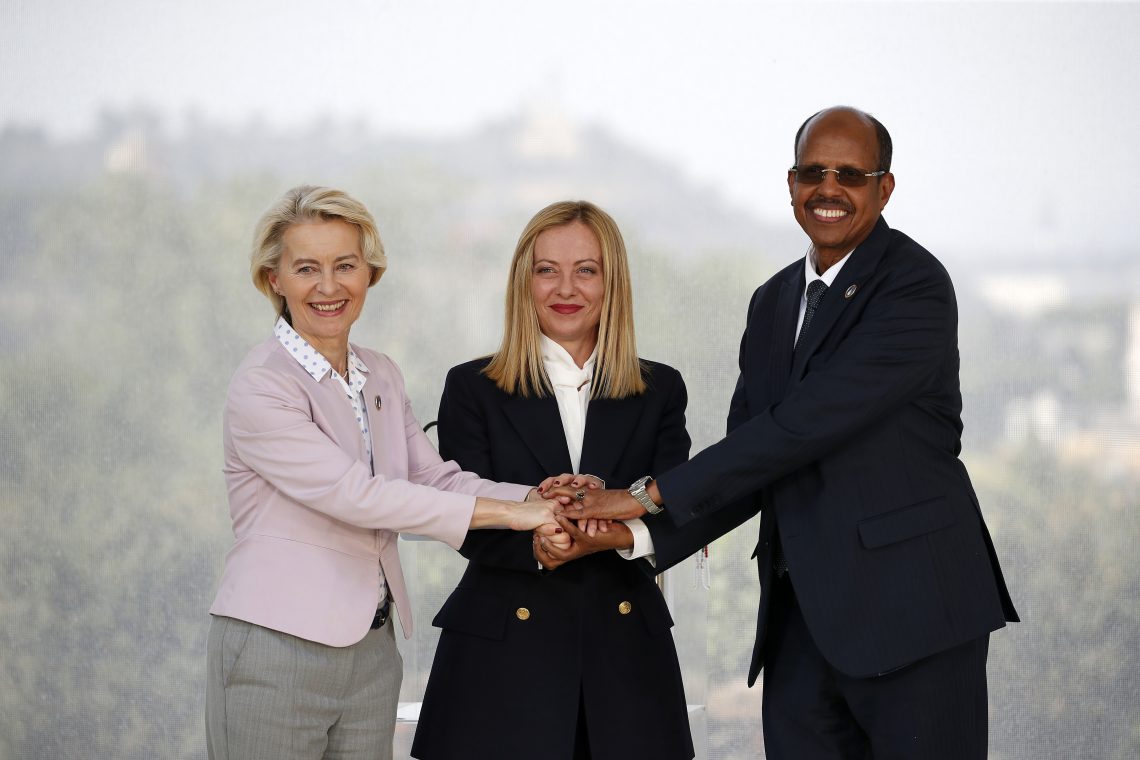
Building on the policies of previous administrations, Italian Prime Minister Giorgia Meloni’s government has made an Italy-Africa strategy one of its hallmarks. Ms. Meloni has described the approach not as “a simple package of projects,” but rather a “new pact among free nations, which choose to cooperate because they believe in the values of the centrality of the individual, the dignity of work and freedom.” According to her, the Italian approach to cooperating with African states as equals is an example that is becoming “a model for many other countries as well.”
The strategy has already achieved significant successes, but some risks remain. The nature of Italy’s current foreign policy means its progress largely depends on the prime minister remaining in office.
Rome’s previous foreign policy
Until 2014, Africa was largely absent from Rome’s foreign policy agenda. While state-owned energy company Ente Nazionale Idrocarburi (Eni) and non-state actors such as the Community of Sant’Egidio – a lay Catholic organization instrumental in mediating the 1992 Peace Accords that ended the 16-year civil war in Mozambique – were active on the continent, diplomatic engagement remained limited.
However, the linkage between geopolitical stability and economic interests, the principle that underpins Italy’s strategic relations with Africa, became clearer in the early 2000s. In 2008, Prime Minister Silvio Berlusconi and Libyan ruler Muammar Qaddafi signed the Treaty of Friendship, Partnership and Cooperation, helping the countries build their relationship around energy, with Libya becoming a key supplier of natural gas and oil and the two cooperating on security matters in the Mediterranean.
The Mattei Plan seeks to break with the previous aid paradigm, in line with the Italian prime minister’s motto for Europe to “do less, but do it better.”
The geopolitical uncertainty unleashed by the Arab Spring uprisings of 2010 and 2011 in North Africa and the Middle East, coupled with increasing refugee flows into Europe, prompted Italy to revise its approach, dedicating greater attention to Africa and to the “wider Mediterranean.”
This renewed interest was matched by concrete diplomatic initiatives led by the Mateo Renzi government (2014-2016), including high-level visits and the establishment of new embassies. Rome also expanded its involvement in African security. In 2013, Italy established the National Support Military Base in Djibouti and, in 2018, launched the Bilateral Support Mission in the Republic of Niger (MISIN), to support local security forces in the fight against terrorism, human trafficking and organized crime. Italy also took part in multilateral initiatives like the United Nations Mission in Mali (MINUSMA) or the Takuba Task Force, a European Union mission in the Sahel that was placed under French command.
Meloni upgrades engagement with African, Gulf countries
In October 2022, during Prime Minister Meloni’s inaugural address to parliament, she named the Italy-Africa strategy the “Mattei Plan for Africa” after the late Christian Democrat politician and founder of Eni, Enrico Mattei. His approach combined prioritizing Italian interests, including the need to secure energy supplies, with a more partnership-oriented strategy. This was embodied in the “Mattei formula,” a 75/25 profit-sharing model that offered more advantages to producing countries than the more prevalent 50/50 arrangement. This was accompanied by political support for decolonization claims and for emerging leadership structures.
Certainly, Europe’s and Italy’s geopolitical challenges today differ from those in previous decades. The current global landscape is marked by fragmentation, a crisis of multilateralism, the exhaustion of the post-Cold War aid system and the reshaping of Africa’s geopolitical order. At the same time, migration has become a key issue in Italian domestic politics.
Against this backdrop, the Mattei Plan seeks to break with the previous aid paradigm, in line with the Italian prime minister’s motto for Europe to “do less, but do it better.”

Unlike strategies from the UN and EU, the Mattei Plan makes few political demands of African partners. It is based on six pillars: energy, infrastructure, water, agriculture, education and training, and health. Energy is a particularly critical domain, as Italy seeks to consolidate its position as an energy hub in Europe and secure a stable supply of resources.
Framed within a realist approach to cooperation with African states, the plan has been accompanied by significant diplomatic efforts. In January 2024, the Italy-Africa Summit, held under the slogan “a bridge for common growth,” was elevated from ministerial to head-of-state level. The plan reflects a pragmatic vision, based on converging interests and a transactional logic: Fostering economic growth in African countries to secure what Italian leaders call the “right not to migrate,” while enabling Italian companies to expand in African markets.
The Mattei Plan brings together multiple stakeholders on both continents, including regional and autonomous communities, state and private-owned enterprises, trade associations and cooperation organizations. However, its activities are run by a steering committee placed under the direct supervision of the prime minister. It was initially focused on Maghreb countries and later expanded to the sub-Saharan region, namely Mozambique (where Eni has a major gas extraction operation in the Rovuma Basin), as well as the Democratic Republic of the Congo, Ethiopia, Kenya and Ivory Coast.
Mattei Plan achievements
Ms. Meloni recently passed the 1,000 days in office mark, a rare achievement in Italian politics, and has emerged as one of Europe’s most pragmatic leaders. On the international stage, she has reinforced transatlantic ties at a time when relations between the EU and United States face mounting strain.
Her time in office and the gradual implementation of the plan has enabled Italy to craft a foreign policy that addresses the country’s national and international interests, particularly as a European and Mediterranean power, while cultivating strategic allegiances, bilateral agreements and multilateral arrangements. It has already delivered results.
Italy’s relations with Tunisia have deepened, especially in the energy and agricultural sectors. Prime Minister Meloni’s administration provides diplomatic support for President Kais Saied and, in return, Tunisia has bolstered its commitment to curbing irregular migration flows to Italy. A flagship initiative for the near future is the ELMED project, a planned electricity interconnection linking Tunisia and Italy across the Mediterranean.
Ties with Egypt have likewise strengthened, expanding into emerging fields such as green hydrogen, while Italy has also played a key role in the EU’s decision to designate Egypt a “safe third country” for the return of asylum seekers.
Algeria, meanwhile, has become Italy’s primary supplier of natural gas, since Italy accelerated its diversification away from Russian energy.

These steps are helping Rome position itself as a reliable partner across the Maghreb and the Sahel – an achievement partly rooted in Italy’s history. Unlike France, in most (but not all) cases, it is not viewed as a hostile former colonial (or neocolonial) power. In 2011, under Prime Minister Berlusconi, Rome notably opposed the controversial NATO intervention to topple Muammar Qaddafi.
With anti-French sentiment in Africa mounting, this legacy has helped Italy increase its role in the Sahel’s rapidly evolving security landscape. For example, Italy is the only Western country maintaining a military presence in Niger. In sub-Saharan Africa, Italy has become involved in Angola’s Lobito Corridor project under the Mattei Plan framework.
Another key initiative is the Blue-Raman submarine-cable project linking Europe to India via the Mediterranean and Eastern Africa. The program is cofinanced by the European Commission and is being implemented by Telecom Italia Sparkle.
The success of the Mattei Plan and Italy’s rising profile in Africa have boosted more ambitious initiatives like the EU Global Gateway and the G7 Partnership for Global Infrastructure and Investment. Moreover, African countries and institutions are becoming more engaged. The African Development Bank has now become a leading financial backer of the Mattei Plan.
Risks to Italy’s Africa strategy
The Mattei Plan’s biggest vulnerability stems from the very forces that underpin its success, namely attempts to find points of convergence between Italian national interests, multilateral initiatives and the interests of African countries. While addressing these areas of mutual interest provides access to critical financial resources, it also requires a constant and sometimes difficult balance that could compromise Italy’s autonomy.
Read more by African affairs expert Teresa Nogueira Pinto
- Accessing Africa’s critical raw materials
- The EU’s new plan to address irregular migration
- Foreign aid in decline as realism shapes global assistance
On the one hand, Italy’s Africa strategy is shaped by the prime minister herself, allowing for more flexibility and adaptability. Ms. Meloni’s ability to manage difficult trade-offs while safeguarding core interests has been a key factor. On the other hand, a strategy that centers so deeply around any individual prime minister runs the risk of being short-lived.
Another risk is the potential for growing tension between Rome and Paris, as Italy increasingly, if only partially, fills the voids left by declining French influence throughout Africa.
Scenarios
The Mattei Plan reflects Prime Minister Meloni’s conviction that political problems ought to be approached with pragmatism and flexibility. Looking ahead, there are two main scenarios for the program’s future.
Most likely: Italy’s engagement in Africa deepens
In the most likely scenario, Italy’s influence in Africa increases as it pushes forward trilateral and multilateral initiatives. This could help mitigate Russia’s growing presence in the Sahel. The plan’s targeted, flexible approach will likely continue with projects in African countries involving other Western actors, such as the EU or the U.S.
Given Prime Minister Meloni’s strong commitment to transatlantic relations, Rome may identify ways for the U.S. to step up its involvement in Mattei Plan initiatives.
As Africa becomes an increasingly competitive geopolitical arena, this scenario also foresees the deepening of strategic trilateral relations between Italy, African states and non-Western actors, namely Gulf countries. This could further shift Africa’s economic and security center of gravity toward North Africa and the Sahel, at the expense of Southern Africa.
Less likely: Italy’s engagement falters as the EU plays a larger role
In a less likely scenario, the Mattei Plan would be compromised by a gradual loss of Italian autonomy, as third parties like the EU assume a greater role in funding and implementing projects with African states. For the EU, stability in the Sahel and North Africa is crucial.
This scenario is less likely, at least in the short to medium term, because Italy is becoming a sought-after European partner, while the EU and other European powers like France are seen as less effective or even as potential threats to African states’ national sovereignty.
More risk to the plan’s viability lies in the possibility of sudden political shifts across Africa, which could jeopardize ongoing projects and long-term commitments.
Contact us today for tailored geopolitical insights and industry-specific advisory services.
Sign up for our newsletter
Receive insights from our experts every week in your inbox.