China’s push to redefine the Dalai Lama’s succession
As the Dalai Lama declares that his successor will be found in the free world, Beijing escalates efforts to appoint its own.
In a nutshell
- The Dalai Lama symbolizes Tibetan sovereignty and spiritual authority
- China seeks to replace the Dalai Lama with a state-approved figure
- Beijing aims to redefine transcendence as a state-made authority
- For comprehensive insights, tune into our AI-powered podcast here
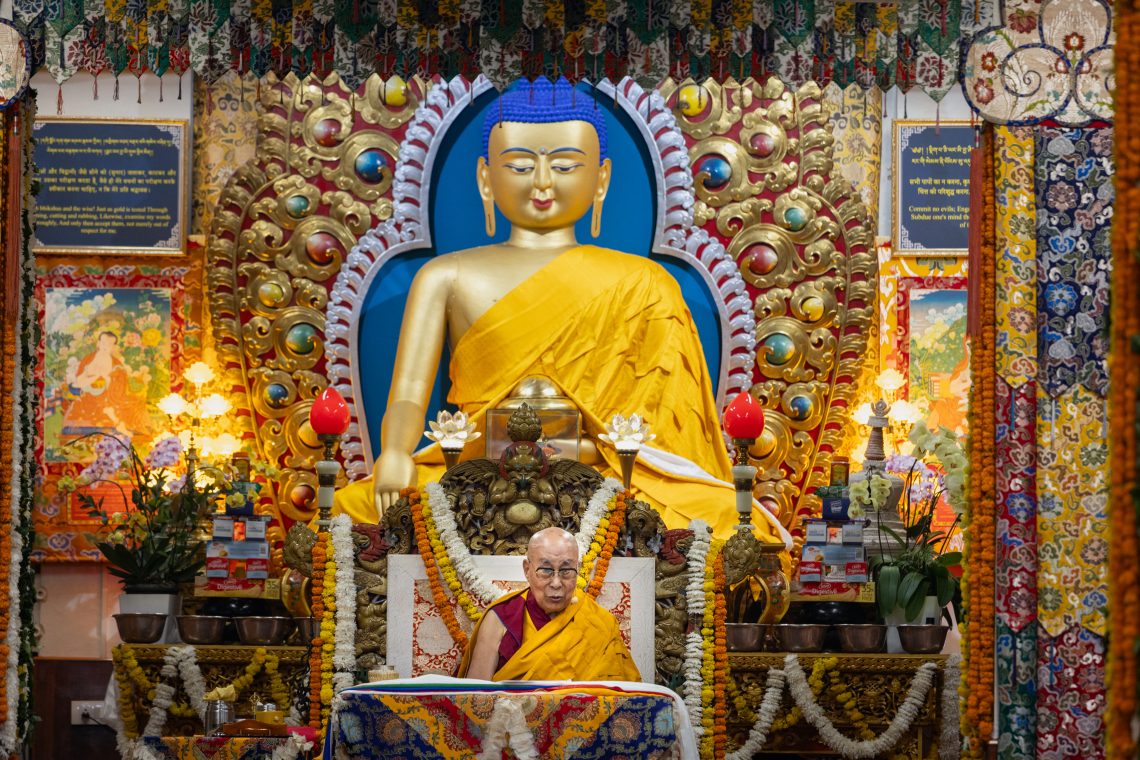
In July, in the northern Indian hill town of Dharamsala – the seat of the Tibetan government in exile – thousands gathered to celebrate the 90th birthday of Tenzin Gyatso, the 14th Dalai Lama. There, he affirmed that, when his time comes, the search for his reincarnated successor will begin, ensuring the centuries-old lineage continues.
In a memoir published months earlier, the Dalai Lama also made clear that this process must take place in the “free world,” beyond China’s reach. Beijing, however, holds a different view. For the Chinese Communist Party (CCP), the Dalai Lama’s rebirth outside its control is an affront to Chinese sovereignty. Since 2007, it has therefore sought to formalize its role in reincarnation, claiming authority over which lamas (spiritual leaders and teachers) may return and under what conditions.
Beijing is unlikely to relent once the current Dalai Lama passes. Its attempts to control the selection of his successor – and the possibility of supplanting him – have remained a continued affront to Tibetan identity with notable geopolitical implications. The Dalai Lama’s spiritual authority extends beyond Tibet to Buddhist nations such as Mongolia and Nepal, where the CCP has long asserted territorial claims. Yet the implications run deeper. The CCP’s continued efforts to appoint the next Dalai Lama represent a profound philosophical inversion, suggesting that the sacred can be recast as a matter of state authorship. This is not only an assertion of control over the Tibetan people; it is an attempt to redesign transcendence itself, unprecedented even in the history of communist parties.

The aura of the lamas
In Tibetan Buddhism, Dalai Lamas are considered the reincarnation of Avalokiteshvara, the Bodhisattva of Compassion and Tibet’s patron saint. As enlightened beings, they consciously choose rebirth to serve humanity, each bearing the spiritual imprint of their predecessors. This lineage is revealed through sacred tradition, not made.
Recognition emerges from ritual: the direction of smoke from the cremation of the departed lama, or birds circling above a village, may indicate where the reincarnation has appeared. A child identified as a candidate is then tested: presented with objects, some belonging to the late Dalai Lama, others placed as decoys, he must recognize what was once his. In this, continuity is confirmed.
The vestments, monasteries and ceremonies that surround the Dalai Lama are essential to his authority, creating what German philosopher Walter Benjamin described as “aura” – the unique and authentic, revealed through ritual and bound to tradition. Aura makes an object or figure more than just itself, anchoring it within a constellation of history, culture and meaning.
The Dalai Lama’s deep saffron and maroon chogu (upper robe), for instance, signifies his renunciation of worldly life, while his Yellow Hat, worn during formal rituals, denotes scholarly authority. East-facing monasteries, with red hues symbolizing spiritual power, serve as spaces for prayer, teaching and preserving Tibetan culture. The Potala Palace – once the Dalai Lama’s winter residence and the seat of the government until China annexed Tibet in 1959 – houses murals, thangkas (Buddhist paintings) and artifacts that narrate Tibet’s history. The Jokhang Temple, linked to his enthronement, houses the Jowo Rinpoche, the most sacred statue for Tibetans.
For the Tibetan people, no institution commands greater loyalty than that of the Dalai Lama lineage, which governed the nation from the mid-17th century until China’s invasion in 1950. It was under the fifth Dalai Lama, Ngawang Lobsang Gyatso (1617-1682), that a long-fractured Tibet, divided by rival sects, factions and Mongol patrons, was unified in 1642 under the Ganden Phodrang (Tibetan government). This unification expanded the Dalai Lama’s role beyond spiritual guidance, making the office the embodiment of both spiritual and temporal authority and the foundation of Tibetan identity.
Even after China’s takeover and despite the Dalai Lama’s exile in Dharamsala since 1959, he has remained the spiritual leader of Tibetan Buddhists and the symbolic figurehead of Tibetan nationhood in exile. His aura is therefore not merely religious but sovereign: proof that Tibet exists not only as a geographical region, but as a civilization with its own sacred political order. It is for this reason that Beijing seeks to quash it.

Beijing’s erasure of Tibetan identity
In April 2023, coinciding with Losar, the Tibetan New Year, China Central Television aired Tashilhunpo, a series that traced the search for the Dalai Lama’s reincarnation back to the Yuan Dynasty (1271-1368). Already since then, the program claimed, it has been China’s central government – and it alone – that has guided these sacred recognitions. “China is the birthplace of Tibetan Buddhism,” the narrator proclaimed, “and the Living Buddhas are Chinese.” In other words, what Tibetans understand as the domain of the sacred is, in the Party’s narrative, authored and possessed by the state.
Over the past decade and a half, the CCP has worked to institutionalize this claim. In July 2007, it issued the Measures for the Administration of the Reincarnation of the Living Buddhas in Tibetan Buddhism – Order No. 5 – under the State Administration of Religious Affairs, now the National Religious Affairs Administration (NRAA) within the United Front Work Department. The order codifies a hierarchical process for approving the recognition of lamas. Applications begin with the temple’s management organization, then move through the county and provincial religious departments. If the reincarnated lama holds “significant impact in the Buddhist world,” like the 14th Dalai Lama, his recognition must also receive approval from both the NRAA and China’s State Council. The order insists that all of this is meant to “safeguard national unity” and promote “religious harmony.”
Yet, for the party, “religious harmony” is less a pluralistic ideal than a tool of control. All religions in China are expected to serve CCP interests, “adhere to the direction of Sinicization of religions” and “embody the core values of socialism,” as outlined in the Administrative Measures for Religious Activity Venues issued in September 2023.
In Xinjiang, for instance, this has meant systematic surveillance and suppression of Islam: mosques demolished, possession of the Quran – even digitally – banned, and Uighur Muslims prohibited from praying during religious holidays. Elsewhere, parts of the Bible have been rewritten, and Christian churches forced to remove the first of the Ten Commandments or replace them with quotations from Chinese President Xi Jinping. The party’s efforts to undermine Tibetan Buddhism and the Dalai Lama are not entirely new, but here it represents its most extreme and audacious expression.
A Dalai Lama appointed by the CCP will point not to the transcendent but to state power. This is a radical proposition, beyond Sinicization, and is unprecedented even among communist regimes.
By 2023, Beijing had assembled 25 senior party officials to choreograph the Dalai Lama’s succession. The CCP’s list of candidates now exceeds 1,300, including lamas it has long groomed within Tibet. Others have been approached with patronage and guarantees of protection should they endorse Beijing’s design. Their role, when the time comes, will be to confer an air of legitimacy to the CCP’s choice. Since 2017, such overtures have been increasingly led by Gyaltsen Norbu, Beijing’s appointed 11th Panchen Lama, the second-highest figure in Tibetan Buddhism. He was installed in 1995 against the Dalai Lama’s recognition. The rightful child chosen by the Dalai Lama vanished into state custody and has not been seen since. In a rare meeting with President Xi this June, Gyaltsen Norbu vowed to make Tibetan Buddhism “more Chinese.”
Similar maneuvers are now being extended beyond Tibet. Senior party officials from Tibet have begun to cultivate Buddhist communities across Asia, most recently in Nepal, Sri Lanka, Thailand and Mongolia, drawing them into Beijing’s succession plans. Foreign trips by Tibetan officials, once rare, have increased over the past two years as part of a deliberate effort to garner support for the CCP’s eventual claim.
Here, spiritual theater doubles as geopolitics. Countries have been pressured to recognize Beijing’s eventual Dalai Lama, or face penalties if they resist. Mongolia learned this lesson in 2016, when a visit by the Dalai Lama caused Beijing to close a key border crossing and suspend loan negotiations. Similar choreography has steadily returned.
Endorsement of the CCP’s candidate in regions where Tibetan Buddhism holds sway could also help Beijing advance its regional interests. Along the disputed 2,100-mile Sino-Indian border, for instance, where Tibetan Buddhists hold deep political and spiritual influence, a pro-Beijing Dalai Lama could provide a sheen of legitimacy to China’s territorial claims, weaken local opposition and shift the balance of power in Beijing’s favor. If nothing else, a scenario of two rival Dalai Lamas, one divine and one engineered, could undermine the idea of a distinct Tibetan identity. For Beijing, that alone would be a considerable victory.

Dalai Lama of China’s design: A copy without an original
More striking than the likely consequences of two rival 15th Dalai Lamas – for Tibetans and the fragile geopolitics of the region – is the deeper message Beijing is sending by orchestrating the succession. It is an erosion of the Dalai Lama’s spiritual and sovereign “aura” through reproduction and control, and an attempt to rewrite not only the political order but also the fundamental nature of what is sacred, legitimate and true. Even transcendence, asserts the CCP, is within the state’s capacity to narrate.
A Dalai Lama designated by Beijing would be disconnected from the rituals, symbols, history and metaphysical elements of Tibetan Buddhism that give the role its aura. What would remain is a state-crafted replica – carrying the semblance of continuity yet stripped of meaning. Take Beijing’s 11th Panchen Lama: he wears the traditional robes of the Panchen Lama lineage, subtly marked with signs of party loyalty. Yet without the rituals and metaphysical foundation that confer legitimacy, the garments are hollow, reduced to mere costume and performance. He is – like Beijing’s Dalai Lama will inevitably be – a “simulacrum”: a copy without an original, a sacred figure without a sacred origin.
A Dalai Lama appointed by the CCP will point not to the transcendent but to state power. This is a radical proposition, beyond Sinicization, and is unprecedented even among communist regimes.
The Soviet Union, for example, rejected transcendence completely, aiming to eradicate religion and establish state atheism as the official orthodoxy. Familiar rites, such as christenings, weddings and funerals, were stripped of their religious significance and replaced with socialist themes. Churches were shuttered and clergy faced persecution.
North Korean leader Kim Jong-un, like his father and grandfather, is revered as omnipotent and quasi-divine. Here, the idea of the transcendent is not eliminated but redirected, with loyalty to the dynasty serving as the only accepted faith.
Read more by Chinese policy expert Dr. Aleksandra Gadzala Tirziu
- China’s cultural conquest of the Arctic
- China’s military expansion: A global power shift in the making
- Inside China’s cognitive warfare strategy
Yet, even these efforts to eliminate or replace transcendence pale compared to Beijing’s initiative against the Dalai Lama. What the CCP seeks is to redesign transcendence itself. In appropriating a living metaphysical lineage and declaring itself arbiter, Beijing insists that the divine is not discovered but made – and that it is the state that makes it. This is a significant inversion where the sacred, which has traditionally existed outside of politics, is recast as a product of it.
Should this effort succeed, the consequences could be vast, reshaping spiritual authority and geopolitical influence alike. Metaphysical legitimacy could become a new domain of power in today’s global rivalry, one that extends beyond technology, military might or economics. If Beijing can point to one of its 1,300 candidates for the next Dalai Lama and declare him divinely enlightened, simply because it says so, then meaning itself becomes contingent: a tool of statecraft.
States may find themselves judged not only on policy alignment but also on their conformity to authoritative meanings. For instance, for countries like Nepal, Mongolia or even European nations, accepting Beijing’s trade terms could require further acknowledgment of the party’s simulacra of the sacred. This would reshape societal perceptions of reality and legitimacy. In this light, the CCP’s attempted engineering of the next Dalai Lama extends beyond control of Tibet – it represents a contest over whether sacred authority can exist beyond the state. Beijing seems to think not.
Scenarios
Likely: Coerced acceptance of China’s chosen Dalai Lama
It is, of course, one matter for Beijing to pursue such an agenda, and another for it to be widely accepted. Apart from a few enclaves, mainly within China, for instance, the party’s Panchen Lama remains mostly unrecognized by Tibetans or the wider Buddhist community. Although Beijing presents him as a legitimate figure, he lacks the aura that lends significance to the role. A similar fate likely awaits any CCP-appointed Dalai Lama: seen as little more than a bureaucratic construct, possibly provoking resistance within Tibet and across Buddhist communities, while undermining Beijing’s intended authority. Nevertheless, the party is likely to continue its efforts.
Coercion, already evident in the travels of Tibetan officials abroad, will likely play its part. While compliance is uncertain, it is still possible. For example, Mongolia barred the Dalai Lama from future visits after 2016, and he has not returned since. Even if initially resisted, too, the CCP’s simulacrum could, through repetition and ritual, eventually gain begrudging acceptance.
Also likely: Two Dalai Lamas and the erosion of Tibetan sacred identity
Should the CCP succeed in installing its chosen Dalai Lama – even if rejected by Tibetans and the broader Buddhist community – the existence of two competing Dalai Lamas could, over time, threaten the foundation of a distinct Tibetan identity, long anchored in the aura of the Dalai Lama. The larger question follows: If figures are severed from their aura and conscripted into the machinery of the state, do they still hold meaning or do they merely become performative?
Beyond Tibet, Beijing’s attempt to reengineer transcendence signals the grandeur of its civilizational ambition. President Xi has long framed ideology and culture as key battlefields in the struggle for his desired new world order. Now that battle extends into the sacred, potentially foreshadowing a new kind of statecraft – one where power is projected by shaping what populations hold sacred, and thus what structures their reality. Other nations, still narrowly confined to calculations of armies and markets, would do well to take note. The stakes, quite literally, are existential.
Contact us today for tailored geopolitical insights and industry-specific advisory services.
Sign up for our newsletter
Receive insights from our experts every week in your inbox.